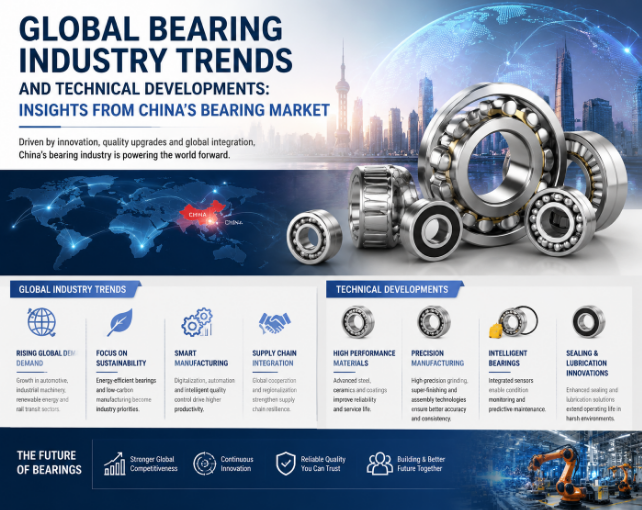
The global bearing industry is undergoing a significant transformation driven by automation, energy efficiency demands, electrification, and increasingly complex industrial applications. Among all global manufacturing hubs, China’s bearing market plays a central role in shaping supply chain dynamics, cost structures, and technological innovation.
This article provides an overview of current global bearing industry trends, key technical developments, and how China’s bearing manufacturing ecosystem is influencing worldwide industrial demand.
Bearings are critical mechanical components used to reduce friction and support rotational or linear movement in machinery. They are widely applied in:
Automotive systems
Industrial machinery
Energy equipment (wind turbines, generators)
Agricultural machinery
Aerospace and precision instruments
The global bearing market is highly competitive and technology-driven, with leading players continuously improving performance in areas such as high-speed operation, durability, and energy efficiency.
Key industry drivers include:
Industrial automation and robotics expansion
Electric vehicle (EV) development
Renewable energy systems (especially wind power)
Demand for low-maintenance and long-life components
China has become one of the most important manufacturing bases in the global bearing industry, offering a complete supply chain from raw materials to finished precision bearings.
1. Complete industrial ecosystem
China has integrated capabilities across steel production, heat treatment, machining, assembly, and testing.
2. Cost-efficient production
Large-scale manufacturing enables competitive pricing for global OEM and aftermarket customers.
3. Rapid customization capability
Chinese manufacturers are highly flexible in producing non-standard, OEM-compatible, and application-specific bearings.
4. Expanding export influence
Chinese bearings are widely exported to Europe, North America, South America, and Southeast Asia.
However, the market is also transitioning from low-cost production to higher-value precision engineering.
Modern industrial applications require bearings that can operate under:
Higher rotational speeds
Higher temperature environments
Heavier radial and axial loads
This has driven demand for:
Hybrid ceramic bearings
High-precision deep groove ball bearings
Low-noise automotive bearings
These products improve efficiency and reduce long-term maintenance costs.
Electric vehicles are reshaping bearing design requirements. Compared with traditional combustion engines, EV systems require:
Higher speed capability
Lower friction loss
Reduced vibration and noise (NVH control)
Improved thermal stability
As a result, automotive bearing technology is moving toward:
Optimized steel grades
Advanced cage materials (PA66, PA46 composites)
Enhanced sealing systems for extended lifetime
Industries are increasingly shifting toward “maintenance-free” or “sealed-for-life” bearing solutions. This is especially important in:
Agricultural machinery
HVAC systems
Industrial motors
Automotive alternators
Key technical improvements include:
Advanced sealing structures
Optimized grease fill ratios
Improved contamination resistance
In applications such as medical devices, robotics, and precision instruments, bearing performance is defined not only by durability but also by:
Low vibration
Ultra-low noise
High rotational accuracy
This is pushing manufacturers toward tighter tolerances and better surface finishing processes.
High-quality bearing steel such as GCr15 remains the industry standard. However, global manufacturers are improving:
Purity control
Heat treatment stability
Fatigue resistance
These improvements significantly extend bearing service life under high-load conditions.
Modern bearing cages are evolving from traditional steel designs to high-performance polymers such as:
Glass fiber reinforced PA66
PA46 engineering plastics
Hybrid metal-polymer structures
These materials provide:
Lower friction
Reduced noise
Improved high-speed stability
Sealing performance is one of the most critical factors in bearing reliability. Modern seals must withstand:
Wide temperature ranges (-40°C to 180°C in automotive applications)
Water and dust contamination
High-speed rotational environments
Advanced sealing structures now significantly improve resistance to:
Water ingress
Dust contamination
Lubricant leakage
Lubrication technology is becoming more application-specific. Key trends include:
Precision grease fill control (25%–35% depending on application)
High-temperature synthetic greases
Extended-life lubrication formulations
These improvements directly impact:
Bearing life cycle
Energy efficiency
Maintenance intervals
China’s bearing manufacturers are increasingly shifting from basic production to engineering-driven innovation.
Key developments include:
Automotive alternator bearing optimization for high-speed EV applications
Agricultural bearing upgrades for harsh environments (dust, mud, shock loads)
Industrial bearing customization for OEM customers
Integration of international testing standards (GB/T, JB/T, ISO equivalents)
This evolution is helping Chinese suppliers move up the global value chain.
The future of the global bearing industry will be defined by:
EVs and renewable energy systems will drive demand for high-efficiency bearings.
Automation and Industry 4.0 will increase precision requirements.
Long-life, low-friction bearings will help reduce energy consumption and maintenance waste.
Companies will continue to diversify sourcing strategies, with China remaining a key supplier base.
The global bearing industry is entering a new phase of technological advancement, where performance, efficiency, and reliability are more important than ever. China’s bearing market plays a crucial role in this transformation, offering strong manufacturing capacity while increasingly focusing on high-performance engineering solutions.
As industries such as automotive, energy, and industrial automation continue to evolve, bearing technology will remain a foundational component supporting global mechanical innovation.