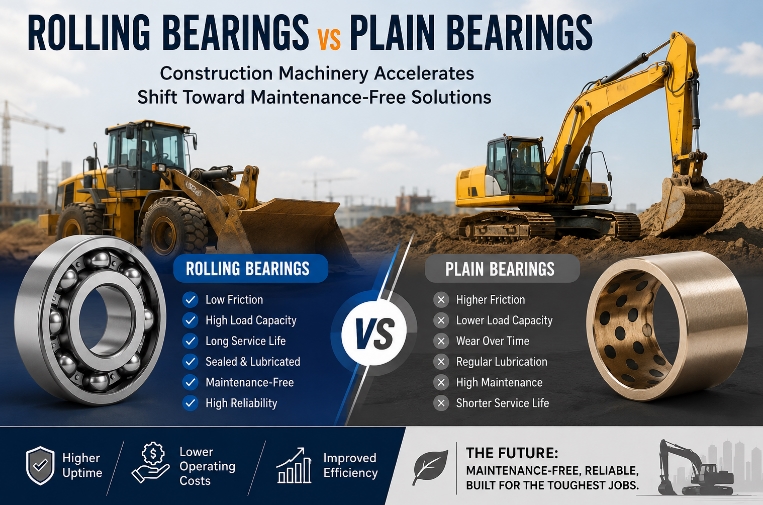
The global construction machinery industry is undergoing a significant technical transition in bearing selection strategy. According to recent industry developments reported by bearing sector media, manufacturers are increasingly shifting from traditional rolling bearings (rolling element bearings) toward maintenance-free plain bearings in specific heavy-duty applications.
This shift is driven by harsher working environments, increasing cost pressure, and the demand for longer service life with reduced maintenance intervention.
Modern construction equipment such as excavators, loaders, and articulated vehicles operates under extreme conditions, including:
High shock and impact loads
Continuous oscillating or pivoting motion
Contaminated environments (dust, mud, sand)
Limited lubrication accessibility
Long service intervals with minimal downtime
In these conditions, traditional rolling bearings often reach their performance limits due to lubrication breakdown and surface fatigue.
A common failure mechanism observed is false brinelling, caused by micro-vibrations and insufficient lubrication film protection during oscillating motion.
Rolling element bearings remain essential in many industrial applications, particularly in high-speed rotating systems. However, in construction machinery articulation points, several limitations become critical:
Sensitivity to contamination ingress
Dependence on continuous lubrication
Risk of fatigue under oscillating loads
Increased maintenance frequency in harsh environments
When lubrication is compromised, wear accelerates rapidly, leading to unexpected downtime and higher total operating costs.
To address these challenges, manufacturers are increasingly adopting advanced plain bearing technologies.
Recent product developments highlighted in industry reports include:
Solid lubrication systems embedded in bearing surfaces
Advanced polymer or composite sliding layers
High load capacity designs reaching up to 300 N/mm² surface pressure
Dry-running or near dry-running capability
Extended service life with minimal or no relubrication
These innovations significantly improve performance in pivot joints, kingpins, and suspension linkage systems.
Modern plain bearings used in construction machinery are no longer simple metal-to-metal contact components. Instead, they integrate advanced tribological engineering:
Composite bearing liners
Fiber-reinforced sliding layers
Low-friction polymer coatings
Embedded solid lubricants
Self-lubricating surface structures
Reduced dependency on grease systems
High resistance to shock loads
Excellent performance under oscillating motion
Strong contamination tolerance
Reduced maintenance requirements
These improvements allow plain bearings to operate reliably in environments where rolling bearings struggle.
The industry is not witnessing a complete replacement, but rather a clear functional segmentation:
| Application Condition | Rolling Bearings | Plain Bearings |
|---|---|---|
| High-speed rotation | Excellent | Not suitable |
| Oscillating motion | Limited performance | Excellent |
| Heavy shock loads | Moderate | Strong |
| Contaminated environments | Sensitive | Highly resistant |
| Maintenance requirement | High | Low / maintenance-free |
This division is reshaping design strategies in modern construction machinery engineering.
OEM manufacturers are now redesigning key mechanical joints with a focus on:
Reducing lubrication system complexity
Extending maintenance intervals
Lowering lifecycle cost (TCO)
Increasing equipment uptime
Improving reliability in extreme environments
As a result, many articulated joints that previously used rolling bearings are now being redesigned with engineered plain bearing solutions.
This transition is also influencing the global bearing supply chain:
Increased demand for customized plain bearing solutions
Greater focus on material engineering capability
Shift from catalog bearings to application-specific components
Emphasis on lifecycle cost over initial purchase price
Suppliers capable of providing both rolling and sliding bearing solutions are gaining strategic advantage in industrial procurement.
Industry experts agree that rolling bearings will remain essential in high-speed and precision applications. However, plain bearings will continue to expand in:
Construction machinery articulation systems
Agricultural heavy equipment
Mining and earth-moving equipment
Low-speed high-load mechanical joints
The future bearing landscape will be defined by application-driven engineering selection, rather than a single dominant technology.
The ongoing shift from rolling bearings to maintenance-free plain bearings reflects a broader industrial trend:From speed-oriented design → to reliability-oriented engineering
As construction machinery becomes more demanding, bearing technology is evolving toward solutions that prioritize durability, contamination resistance, and reduced maintenance dependency.
This transformation is expected to continue accelerating as OEMs seek lower total cost of ownership and higher operational uptime in global heavy equipment markets.