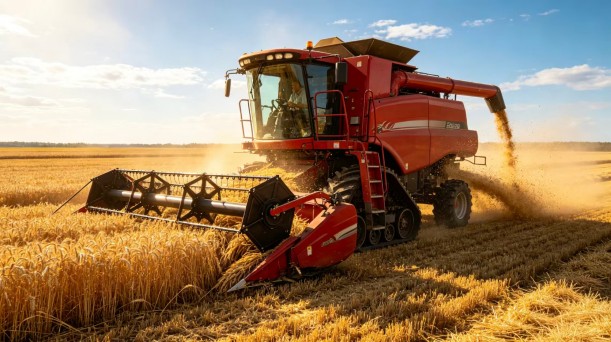
Agricultural machinery operates in one of the most demanding environments for mechanical components. Bearings used in this sector must withstand shock loads, contamination, and long continuous field operation without failure.
Typical bearing installation points include:
Tractor wheel hubs and axle systems
Transmission shafts and drive rollers
Harvester threshing drums and cutting systems
Crop crushing and shredding assemblies
Seeding and feeding mechanisms
Conveyor and material handling systems
These systems operate directly in soil, dust, crop residue, and moisture-rich environments.
Agricultural bearings must perform under:
Severe shock and impact loads from uneven terrain
Continuous exposure to dust, mud, and sand particles
Water, humidity, and seasonal weather variations
Heavy radial loads combined with misalignment risks
Long operating cycles during harvesting seasons with minimal downtime tolerance
In practice, many bearing failures in agricultural equipment are not caused by load rating limits, but by contamination ingress and improper sealing or selection.
For agricultural machinery, reliability and sealing performance are critical:
Deep groove ball bearings – widely used in general rotating assemblies with effective sealing options
Tapered roller bearings – suitable for heavy-duty axle and transmission load conditions
Needle roller bearings – ideal for compact, high-load drivetrain points
Cylindrical roller bearings – used in robust radial load environments such as harvesting drums
In harsh field conditions, sealed designs and grease retention capability often determine real service life more than theoretical specifications.
For international OEMs, wholesalers, and equipment manufacturers, bearing selection is not only a technical decision—it is a cost control strategy across the entire product lifecycle.
Key procurement priorities typically include:
Reducing unexpected downtime and warranty claims
Extending maintenance intervals in harsh environments
Ensuring stable performance across different operating regions
Standardizing components for global supply chains
Balancing cost efficiency with long-term reliability
This is why more buyers are shifting from “price-based purchasing” to application-driven bearing selection based on real working conditions.
For engineering-driven industries, suppliers must provide more than standard catalog products. What matters is the ability to support:
Customized bearing solutions based on load and environment
Material and sealing optimization for specific applications
Stable mass production quality for OEM supply chains
Technical support for selection and failure analysis
Long-term supply consistency for global distribution