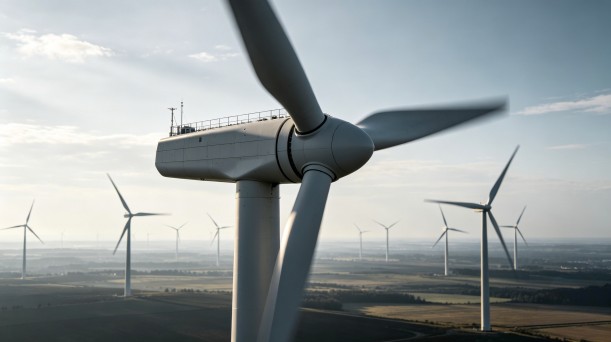
In the new energy power sector, wind turbine systems place far higher demands on bearings than conventional industrial equipment. Wind turbines operate continuously in high-altitude, offshore, or desert environments, where they are exposed to unpredictable natural conditions and constantly changing load patterns. Bearing failure not only leads to extremely high maintenance costs but also directly impacts power generation efficiency and the revenue of the entire wind farm.
The bearing system in wind turbines is mainly distributed across the critical drivetrain components:
Main shaft support system (Main Shaft)
Gearbox transmission system (Gearbox)
Yaw system (Yaw System)
Pitch mechanism (Pitch System)
These components collectively determine the operational stability of the turbine under varying wind speeds and changing wind directions.
Bearing failures in wind turbines are usually not sudden breakdowns but the result of long-term accumulated damage. This makes material selection and structural design extremely critical:
Long-term outdoor operation exposed to wind, sand, salt mist, rain, and snow
Large temperature variations between day and night and across seasons
Frequent alternating loads caused by constantly changing wind conditions
Ultra-long service life requirement (typically 20+ years design life)
Low-speed heavy load combined with micro-motion wear
Offshore wind turbines face additional high humidity and high salinity corrosion risks
Under such conditions, bearings are not just rotating components—they are the core of overall system reliability and service life.
Depending on different turbine structures and system requirements, the following high-reliability bearing solutions are commonly used:
Spherical roller bearings: Widely used in main shafts and gearboxes; excellent self-aligning capability for heavy load and misalignment conditions
Tapered roller bearings: Suitable for combined radial and axial loads, commonly used in gearbox transmission ends
Cylindrical roller bearings: High radial load capacity, ideal for high-power transmission systems
Angular contact ball bearings: Used for precision support and high-speed shaft positioning
Wind turbine slewing bearings (slewing ring bearings): Used in yaw and pitch systems for low-speed, high-torque rotational control
Compared with construction machinery, wind power applications face unique engineering challenges:
Continuous long-term operation with minimal maintenance downtime
Significant micro-motion wear under low-speed oscillating conditions
Difficult to maintain stable lubrication over long cycles
Accelerated corrosion in offshore environments
Early-stage damage is difficult to detect during operation
In many cases, performance degradation occurs long before visible failure is detected.
For wind turbine OEMs and operators, bearing selection typically focuses on:
20+ year design life and long-term reliability
Resistance to fatigue and micro-motion wear
Sealing performance and lubrication stability
Material purity and heat treatment quality
Availability of wind-power-specific reinforced designs
Corrosion resistance for offshore and high-humidity environments
The core requirement for wind turbine bearings is not simply load capacity, but long-term stable operation without failure. In the rapidly growing renewable energy sector, bearing performance directly affects power generation efficiency and the return on investment of wind farms.
Selecting the right bearing solution is essentially a decision to reduce long-term operational risk rather than simply lowering procurement cost.